

Lashed on LinkedIn
On my first social media controversy and upsetting the (fundraising) establishment.

For the first time in my life, I caused a stir on social media last week when my LinkedIn post made me the target of a pile-on. Those of you who are connected with me on that platform will probably have seen it – because, while not my most viral post ever, 10,000 impressions and counting is far beyond the usual reach of my content. It’s particularly remarkable given the post still only has a dozen likes.
The inspiration for my LinkedIn post was a piece of charity mail I received from a large, reputable organisation. The envelope was unnamed and unaddressed – basically the equivalent of a cold call.
I found it mildly annoying as I do all junk mail, a little surprising that they were asking for money from a perfect stranger and calling me “Friend”, and a little intriguing that it must have a good chance of working if they’re dropping what must be tens of thousands of these around Australia.
So I asked the LinkedIn universe: What are your thoughts on this as a fundraising tactic?, hoping to hear from both fundraising professionals and non-industry people who had received similar mailings.
Instead, I upset the fundraising establishment. I didn't even know there was one, silly me.
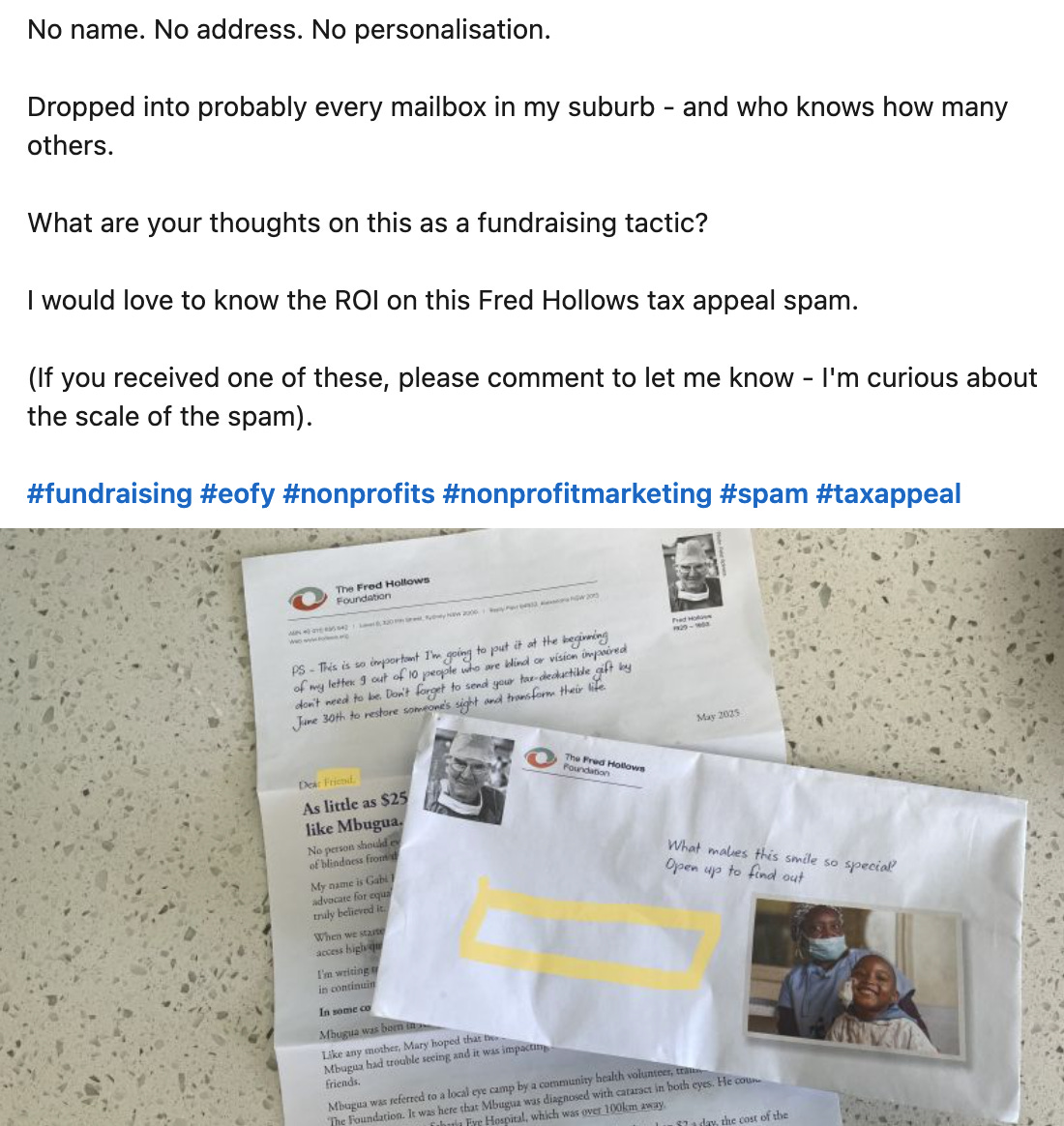
Okay yes, I may have used the word spam.
I’ll also concede it wasn’t a “polite” post – but it certainly wasn’t designed to shame anyone.
I wanted to start a conversation about fundraising tactics. I led with an opinion.
But all these fundraising people took it SO PERSONALLY. They pretty much sucked the air out of the room for anyone to offer an alternative take.
Some people took the time to engage meaningfully with me, politely disagreeing and elaborating on their own methods and experience. I could kind of tell they were peeved but trying hard to stay professional. I appreciate their efforts, even though at times I wanted to yell I’VE BEEN CREATING DIRECT MAIL SINCE 2018, YOU DON’T NEED TO TELL ME THESE LETTERS WORK.
Quite a few felt the need to defend the charity in question, which seems absurd to me because they are one of the largest in Australia and well-regarded. Even if I had been attacking them, what do they care what I say about them? I’m no risk to them in any way whatsoever.
Then there were people who got quite indignant:
“One of the fundamental tenants of the fundraising institutes of both Australia and New Zealand is not to disrespect other charities. This post is borderline at best. If you don’t like it, bin it. Dragging a respected charity into the Linked In space with no other intent than to criticise is pretty low in my book.”
“It’s okay to try something new (or not so new). It’s not okay to shame others for doing so.”
“Yikes, this post is really unprofessional and unpleasant.
That aside, every for-purpose right now is under tremendous pressure and testing new things, so good on them. They will certainly test the ROI and make a decision based off that on how they proceed, if we don’t allow organisations space to test then there will be no change in strategy and they will fail. Then they will be attacked for not trying new things.
In addition, your question on ROI is really shortsighted and basic marketing strategy should look to Lifetime Value as well as ROI.
For example even if the cost of the campaign was greater than the revenue, if the organisation has identified a new audience the long term value will outstrip the initial cost.”
I don’t think they would say these things to my face. That first comment is from the leader of a Christian nonprofit, which makes it extra disappointing.
*
I’d be lying if I said it’s fun being on the receiving end of these sorts of comments. The ick feeling stuck with me for the first 24 hours.
I resisted the urge to be snarky, or to justify myself. It wasn’t worth it. I also chose not to take their words personally – they don’t know me. Perhaps these comments say more about the commenters than about me or what I wrote. If I had career aspirations to work for “establishment” charities, I might be worried about having put my future job prospects in jeopardy – but I don’t.
A couple of colleagues liked my post in a show of support. There are still three times as many comments, and likes on the snarky comment above, than on my original post.
My husband was going to comment in my defence but then decided his last name would give away his connection to me.
A guy I hadn’t spoken to in years and years private messaged me, offering to chime in. He encouraged me to not let the haters get to me.
A friend (also in the sector) agreed some of the remarks were harsh and probably related to my use of the word spam plus the fact that all these people make their living creating direct mail advertising for charities.
*
Perhaps the lesson for me is “Be careful what you publish” – but the thing is I am careful, and it still happened. This was not an impulsive post from me. My general practice is to think before I publish, which is likely why I never found my feet on Twitter/X.
Perhaps I should be diplomatic and play it safe. I could’ve been nicer in my tone and language. I could’ve redacted the name and logo of the charity. I could’ve included an explanation that I work in the industry. (I could’ve not used the word spam).
But I don’t think I had any obligation to do that. I don’t think my failure to do those things warranted the criticism I received.
And ironically, this experience has kind of made me more determined to speak my mind. Blame it on my contrary streak, if you like.
*
This episode has been a reminder that the internet loves and rewards outrage – even LinkedIn, which is supposedly more positive and professional. And Substack is not immune either, based on some comments I’ve seen.
After all, outrage → engagement (comments) → reach → virality.
No thanks, not for me.
It makes me wonder if it’s even possible to have the kind of conversations I want to have on a one-to-many digital forum. It seems not, and that’s sad.
Anyway, if you’re curious, you can find the original post here. I know many of you will back me because you know me personally and understand that my intentions were not malicious. I also suspect some of you will think my post was unwise and unhelpful. If so, feel free to let me know privately – or, y’know, comment on my LinkedIn ;)
Curated by me
🎵 I have never been into Miley Cyrus, not at all. Not when I swallowed every last drop of pride in me to lip sync ‘Party in the U.S.A.’ for a friend’s birthday video tribute. Especially not when ‘Wrecking Ball’ was playing and meme-ing literally everywhere. But then I stumbled upon ‘Slide Away’. I thought, okay, an exception — see how open-minded and not a snob I am? Then I realised that Miley’s vocal range is similar to my own (lower than the average woman). Then I listened to her new album Something Beautiful and — unnecessary expletives aside — y’know what? I like it.
📝 Should companies get behind causes? Is it tokenistic, opportunistic or can we see the corporate sector as a serious vehicle for meaningful change in the world? Whether you are generally for or against, this article does a good job of exploring this succinctly.
📝 The Spirit in the Blue Light is not a classic European folk tale I’d ever come across. I’m guessing you probably haven’t either. Read it (and some reflections on whether there’s a modern analogy to be made) here.
📝 This Q&A with a refugee woman is really powerful. She’s done an incredible job responding thoughtfully and poetically in English, which is not her first language. Disclaimer: I wrote the questions and the charity I work for helped her obtain permanent protection in Australia.
Social media presses everyone's limbic response buttons. I'm sorry people reacted like that. Like Internet gambling in the UK, we should all have to wait 48 hours before replying to any post we read. I'm sure anyone's ire would wear off by then.
I have no comments on Charities. However, the first thought came to my mind when I read your article was that "the internet makes people more divisive". You think social media would accommodate different ideas and make the world more diverse, but no. Lots of people take opinions personally, and become angry and then attack those whoever disagree. Isn't it like dictatorship, not allowing different ideology, burning books, brainwashing people with unified ideas, even killing people who disagreed and expressed publicly their opinions? Is there any difference between the extreme left and the extreme right?
This also reminds me of a commercial about how to eat mix nuts. The two comedians argued if mix nuts should be eaten one by one, or a handful of mix ones put into mouth together. They both had good reasons, but couldn't convince each other, so they decided to post online and see people's opinions. This stirred the whole internet and people even protested on the street. The commercial is not at all exaggerating. See the world nowadays, how many people especially celebrities got cancelled and personal attach when they express some unpopular ideas?
I always believe the nature of human beings never changes over thousands of years of evolution. However, technologies exposes the nature so we can see ourselves more clear. We might have been always divisive, and internet helps us to see how divisive we were, we are and we will be.